Countering electromagnetic denial
The spectrum is being deniedWe find who is doing it
UAV-borne counter-denial. We start with the loudest form of it:
communications jamming.
Context
Modern warfare depends on sensing.Sensing needs access to the electromagnetic spectrum.That access can no longer be assumed.
For decades, military advantage has been built around increasingly capable sensors, communications and autonomous systems. Longer-range radar. Better ISR. Precision weapons. AI-enabled platforms. All of them need the electromagnetic spectrum to see, navigate and operate. The spectrum is no longer an enabler. It is contested terrain.
Denial changes the equation.
The adversary does not have to defeat the aircraft, drone or weapon. It can attack the environment those systems depend on. Jamming overwhelms receivers. Navigation becomes unreliable. What the sensor is looking for can be hidden. Communications go dark.
The result is a structural asymmetry: the best sensor is useless if it cannot see. The best autonomous platform is compromised if it cannot navigate or talk. Freedom of action starts with finding what is taking it away — and it is taken away in a sequence: comms first, then positioning, then vision.

Our mission
SPHYR builds UAV-borne counter-denial technology
to restore freedom of action in contested electromagnetic environments.
Because freedom of action starts with finding what is taking it away.
What gets denied
Denial hits comms first, then navigation, then what the sensor can see. Lykos is the first payload: find the jammer.
Communication
Radio links drop. Video feeds cut out. Command and control goes dark. This is where we start.
Positioning
GPS is jammed and spoofed constantly. If a drone doesn't know where it is, nothing else it sees matters.
Vision
Netting, smoke, weather, darkness. Not electromagnetic — but it still hides what sensors are looking for.
Lykos — chapter one
Find the jammer.Tell the operator where it is.
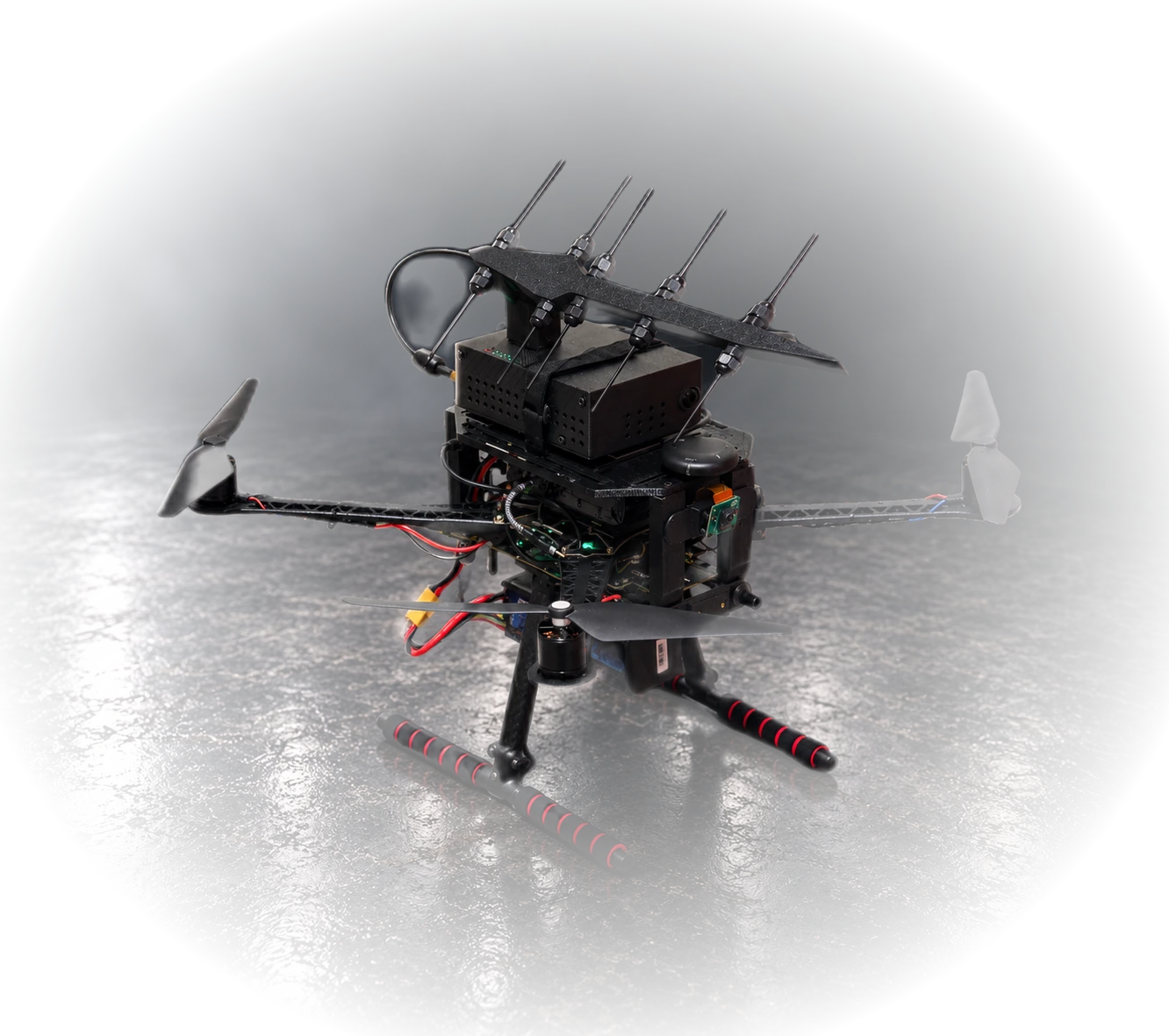
Power-based detection fails at range.
Most jamming detectors look at how loud the jammer is. That does not work when you are far from it. Lykos uses onboard AI to pick up subtle signatures in the spectrum and locate tactical jammers from several kilometres away — then tells the operator where the denial is coming from. It listens. It never transmits.
- Fly it on an FPV drone or a larger multicopter.
- Listen. The payload is receive-only. No emission, no extra signature.
- Detect and locate onboard. The model detects and locates the jammer in real time at the edge, while guiding the platform to build angular diversity and improve localization accuracy.
- Act. The operator gets a location to avoid, prosecute, or hand off. Lykos is a sensor, not a hunter.
FPV and multicopters
Compact form-factor. Made to fly on lightweight platforms.
Attritable
Built with COTS components and 3D-printing for affordability and operational use.
Onboard AI
Signature-based detection, not power-based. Built to detect jammers kilometers away, not only the ones next to the aircraft.
Receive-only
Passive detection and location of communications jammers — the payload never transmits.
3D-printed and replaceable antenna.
Directional beam covering radio command link frequencies.
Compact form-factor.
Based on software-defined radio technology for maximum agility.
AI models with edge acceleration for real-time, onboard inference, so the operator gets a location, not a raw spectrum plot.
Protection of the receive chain from strong out-of-band emissions, to prevent saturation and preserve detection performance.
Supported by




Denial is loud.We're built to hear it.
Have a platform or a programme that needs a receive-only jammer-hunting payload? Let's talk.
contact@sphyr-systems.com